

Virtual Temperature Buffering vs. Physical Glycol Buffers: Why One Size Doesn’t Fit All in Pharmaceutical Cold Storage Monitoring

One buffer can’t represent every product in your fridge. Here’s what we built instead.
If you’ve ever worked around a pharmacy refrigerator, you’ve seen the little glycol bottle sitting next to the vaccines with a probe stuck in it. That bottle is called a temperature buffer, and it’s been the industry’s answer to a simple, important problem in pharmaceutical cold storage temperature monitoring for decades: air temperature swings too fast and too wildly to be a trustworthy stand-in for how a stored product actually experiences its environment. A door opens for ten seconds and the air temperature spikes; the vaccine inside its box barely notices. Buffers exist to smooth that out, to answer “what is the product actually feeling?” instead of “what is the air doing right now?”
It’s a good idea. It also has a blind spot that gets more obvious the longer you think about it: a single buffer can only really represent one thing.
The mismatch problem
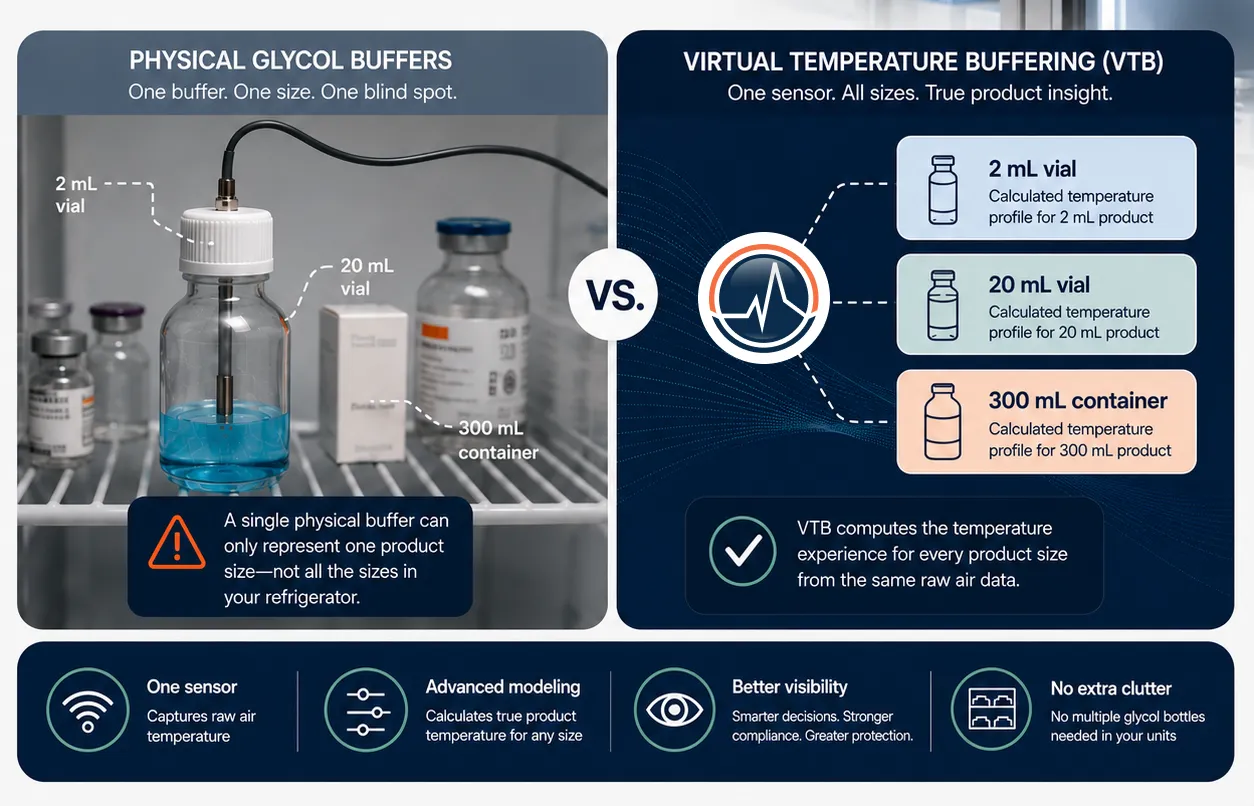
Picture a standard pharmacy refrigerator. It might hold 2 mL vaccine vials, 20 mL multidose vials, and a 300 mL bulk container, all at once. The glycol buffer monitoring that unit was sized and built to represent one of those, usually whatever the probe manufacturer happened to standardize on, often without much science behind the choice.
Think of a physical buffer as a hearing aid tuned to filter out high-pitched sounds. It faithfully reports slow, gradual temperature changes while quietly filtering out the fast spikes. That’s exactly what a small vial needs protection from, and exactly what a 300 mL container barely feels anyway. Swap in a 2 mL vial where a 300 mL buffer is doing the listening, and the alarm system is now tuned for a product that isn’t there. It will miss real excursions the small vial actually experienced, and it can’t tell you anything about the 300 mL container’s own risk either, because a fixed-size buffer only speaks for its own size.
Multiply that across every SKU, every pack size, every unit in a facility, and you start to see the scale of the gap. This isn’t a hypothetical: it’s something we’ve published on and measured directly, going back to a 2018 study quantifying exactly how much buffer size and material mismatch can throw off a temperature reading.
What we did about it
Our answer is Virtual Temperature Buffering™ (VTB™). Instead of picking one physical bottle and living with its limitations, VTB™ keeps the raw air-temperature record intact — nothing is thrown away — and then computes, on top of that same data, what each individual product volume in the unit would actually be experiencing. A 2 mL vial and a 300 mL bottle can be characterized from a single monitoring point, simultaneously, without needing eight different glycol bottles crowding the shelf.
The underlying idea is one you already know from everyday life. Newton figured out centuries ago that a warm object cools toward room temperature gradually, not instantly, and how quickly depends on the object’s size and material. VTB™ models that same relationship computationally instead of physically. We’re not guessing at how a product responds to its environment; we’re calculating it, the same way a real bottle would settle into a new temperature, just without needing an actual bottle sitting there.
Why we’re confident in it
None of this is new theorizing for us. It builds on more than a decade of published, peer-reviewed research on buffer accuracy, sampling adequacy, and the ways cold chain monitoring can quietly go wrong, and it’s about to get its most rigorous test yet: a forthcoming paper in ISPE’s Pharmaceutical Engineering that includes a six-day, side-by-side comparison of VTB™ against a physical glycol buffer, monitored simultaneously on the same shelf. The result: the two tracked each other within 0.02°C on cumulative thermal exposure, with strong correlation once a small, physically expected lag between the two measurement approaches was accounted for.
We think that’s a meaningful validation step, and we’re glad to point people to the paper once it’s published. We also want to be straightforward about what it does and doesn’t mean: no regulatory body — not CDC, not FDA — maintains an approved-buffer list, for physical buffers or computational ones. What every framework we’ve reviewed actually asks for is functional: does the monitoring approach represent what the product is really experiencing? That’s the standard VTB™ is built to meet, and it’s the standard we keep testing it against.
The takeaway
A temperature buffer’s job has always been to answer one question honestly: what is this product actually feeling? A single physical bottle can only answer that question for whatever it was built to represent. Preserving the full data record and computing the answer for every product size at once — instead of guessing with one bottle for all of them — is a better way to get an honest answer, and it’s the reason we built VTB™ the way we did.
Have questions about how VTB™ works, or want to see the validation data yourself? Book a demo — we’re always happy to talk shop.



.svg)
