3 Cold Storage Cyberattacks in One Month: How to Protect Yours

In three weeks, attackers took over refrigeration controls at hundreds of European supermarkets and three French blood bank sites. The Pentagon is investigating similar failures on U.S. military bases.
Between October 12 and November 2, 2026, attackers remotely changed temperature settings on refrigeration systems at hundreds of supermarkets across Europe and at three plasma cold-storage sites run by France's national blood service, the EFS. The blood bank didn't lose a single unit, because its alarms flagged the change fast and staff moved the product. That's the takeaway for every hospital, blood bank, and lab running connected cold storage: the system that controls your freezer shouldn't be the only thing watching it.
Most people hear "cyberattack" and picture stolen passwords or a ransom note. Nobody pictures a plasma freezer that normally sits at -22°F being told to run at 230°F. That's where we are now, though.
What happened, newest first
- Nov 2: A refrigeration supplier serving three EFS plasma sites in France is compromised, with temperature and defrost thresholds pushed as high as 230°F (110°C). Outcome: Alarms caught it. Plasma was moved or secured. No blood products lost.
- Nov 2: A second wave hits supermarkets in seven more countries, including Belgium, Sweden, the Netherlands, and Ireland, with some freezers set to 122°F (50°C). Outcome: Stores throw out food. The controller maker says unpatched systems were the ones hit.
- Oct 29 (suspected, unconfirmed): Reuters reports the Pentagon is treating late-August freezer failures at six or more U.S. military commissaries as a suspected cyberattack. Outcome: Food spoiled. Cause not yet confirmed.
- Oct 12: Hundreds of French supermarkets, including Intermarché and Coopérative U stores, lose control of their refrigeration. Outcome: France’s finance minister puts it at about 700 of the country’s 10,000 supermarkets. Some stores report fires.
The blood bank attack: caught before it cost anything
On Monday, November 2, someone got into a refrigeration equipment supplier that services three EFS cold-storage sites. From there, they raised the temperature and defrost thresholds on rooms holding plasma for transfusions and plasma bound for drug manufacturing.
The French weekly Le Canard Enchaîné, which broke the story, reported the attackers tried to push rooms that normally hold -22°F (-30°C) up to 230°F (110°C). Nobody drifts 250 degrees by accident. Someone was trying to cook the inventory.
It didn't work. EFS says its monitoring and alarm systems spotted the anomaly quickly, staff moved or secured the product, and no blood products were lost. Collection and distribution to hospitals never stopped.
What saved them wasn't a firewall or a patch. It was an alarm that went off and somebody who did something about it.
Look at where they put the plasma, too. An EFS spokesperson told Reuters the staff moved it to refrigerators that weren't connected to the compromised system. Hold onto that detail, because it's the whole argument of this piece.
The supermarkets were the warm-up
The blood bank wasn't the first target. On October 12, hundreds of French supermarkets lost control of their fridges and freezers in a coordinated attack on their refrigeration controllers. France's finance minister said about 700 stores were hit. Shelves got emptied into dumpsters, and a few stores reported fires.
Three weeks later it happened again, wider. On November 2, chains in Belgium, Luxembourg, Sweden, Finland, Ireland, Estonia, and the Netherlands reported freezers climbing toward 122°F (50°C) overnight. The controller manufacturer said the stores hit were the ones that hadn't updated their software.
Nobody stole any data. They just changed a number on a screen, and the equipment did the rest.
A U.S. case is still open
This isn't only a European story. On October 29, Reuters reported that the Pentagon is treating a string of late-August freezer failures at six or more U.S. military commissaries as a suspected cyberattack. At Fort Huachuca in Arizona, every commissary freezer reportedly switched into defrost mode overnight.
Investigators haven't confirmed a hack, for the record. A freezer going into defrost can be a plain old malfunction.
At 2am in a hospital, though, the cause doesn't matter yet. Mechanical failure, power blip, human error, or attacker, your team still has to find out fast and move product. The root cause can wait until morning.
Why a grocery store problem is now a healthcare problem
A supermarket that loses a freezer loses ice cream. A blood bank loses units it can't replace on short notice, at $300–500 each. An IVF lab or a cell therapy program can lose material that literally doesn't exist anywhere else.
And healthcare runs on the same kind of equipment that just got hit. Ultra-low freezers, pharmacy fridges, cold rooms, and cryogenic storage increasingly ship with digital controllers, remote access, and a vendor who can log in to service them. That's convenient right up until someone else logs in.
The EFS attack is the one to study. Attackers didn't break into the blood service directly. They went through a refrigeration contractor with access to the equipment, which is exactly how most facilities let service vendors work today.
Don't let the freezer watch itself
The biggest lesson from all of this is about architecture, not passwords.
If the same controller, network, or vendor platform both runs your freezer and reports on it, an attacker who owns that system can change the setpoint and quiet the alarm in one move. You'd find out when someone opens the door. Reporting on the EFS incident says the attack touched both monitoring and control systems at the affected sites, which makes it even more striking that the alarms still got through.
The fix isn't to rip out connected refrigeration. It's separation. Controls manage the equipment. An independent monitor, on its own sensors and its own connection, tells you what's actually happening inside the box. When those two can't be taken down together, one compromised system doesn't leave you blind.
AI is about to make this a lot cheaper
There's no public evidence that AI was behind the freezer attacks. But there's a clear preview of where this goes, and it already happened at a water utility.
In May, the industrial security firm Dragos published its analysis of a breach at the municipal water and drainage utility serving Monterrey, Mexico. The attackers leaned on two commercial AI models (Anthropic's Claude and OpenAI's GPT) to do most of the technical work. Dragos found that the AI spotted the utility's industrial control gateway on its own, researched the vendor's documentation, and launched an automated password attack against it. The attackers had shown no real knowledge of industrial systems. The AI filled that gap for them.
They didn't get in. The password attack failed, and Dragos found no sign the control systems were touched. But two details should stick with anyone who owns cold storage. The AI found the industrial system within hours of getting inside the network, and it built attack tools in hours that Dragos says would normally take days or weeks.
Dragos is careful to say this isn't some new superweapon. The AI didn't invent anything. It just took old, well-known tricks (default passwords, weak logins, unpatched equipment) and ran them faster and at scale.
And those are exactly the weaknesses behind the freezer attacks. The controller maker said the stores hit on November 2 were running software that hadn't been updated. The threat intelligence firm Lupovis says it watched attackers try to log in to those same controllers from October 20 to 30, mostly with factory-default passwords that are published online. Two days later, the second wave hit.
Put those together and the math changes. Hitting hundreds of supermarkets used to take a skilled, patient crew. As AI gets better, it takes less skill and less time, and every unpatched controller with a vendor login becomes a target worth trying.
Why prevention alone won't cut it
If healthcare underlines one line in the Dragos report, it should be this one: as AI models improve, security built only on prevention keeps losing ground. Firewalls, patches, and password changes still matter. But you also need a way to see when something gets through anyway.
For a blood bank or a pharmacy, "something got through" looks like a setpoint quietly changing at 3am. You won't out-patch every attacker who now has an AI doing the legwork. You can make sure you hear about it in minutes instead of finding out at the morning check.
Monitoring that doesn't share a network with your freezer
PharmaWatch was built cellular-only for this reason. Our sensors never join your WiFi or your building network, and they don't talk to your refrigeration controller. If someone takes over the freezer's controls, they haven't touched the thing that's watching it.
What that looks like day to day:
- Its own connection. Each sensor talks over multi-carrier cellular (Verizon, AT&T, T-Mobile) and hops to whichever signal is strongest. IT never hands over a network password or touches the firewall.
- Readings every 5 minutes, sent to globally redundant cloud servers. You see an excursion while there's still time to act on it.
- Alerts that don't give up. Call, text, email, or all three, and if nobody acknowledges, an admin gets pulled in. We built it so a 2am alarm can't quietly go unanswered.
- 5 days on battery. Power outages, IT maintenance, the mess after an incident. The record keeps running through all of it.
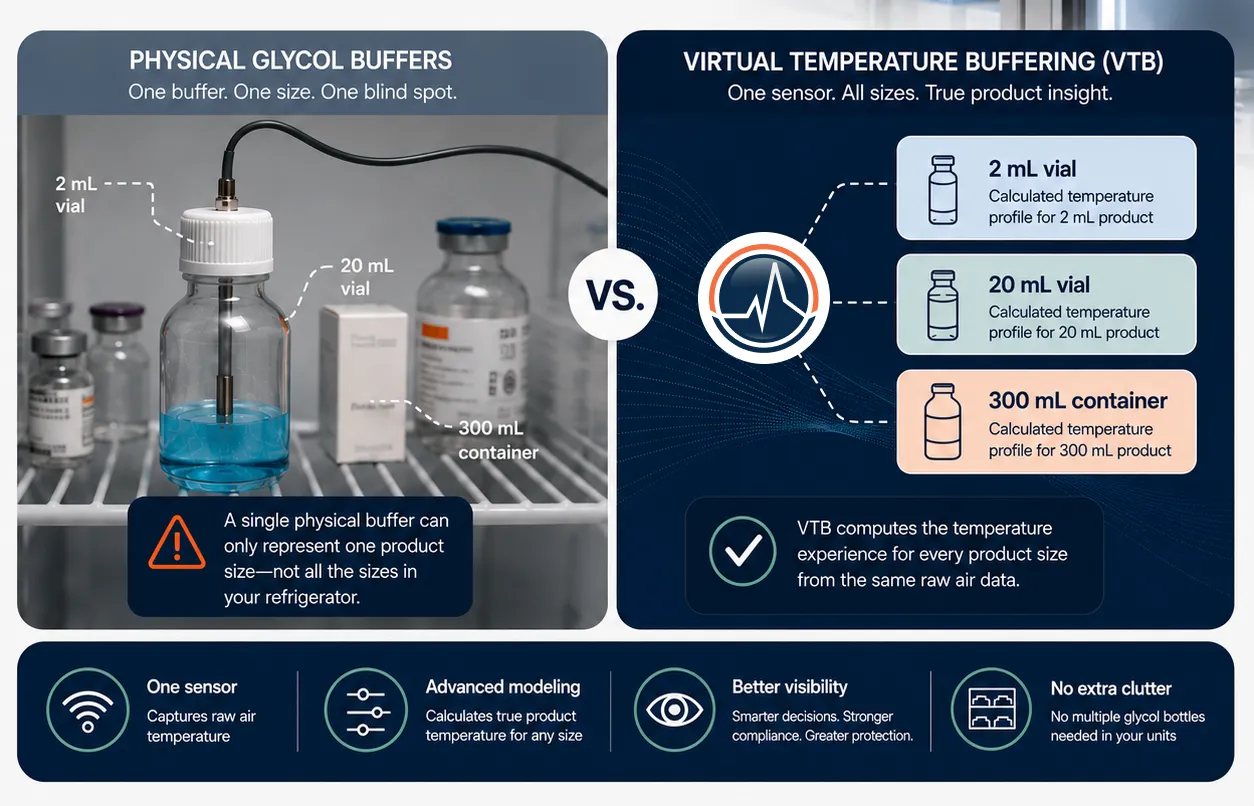
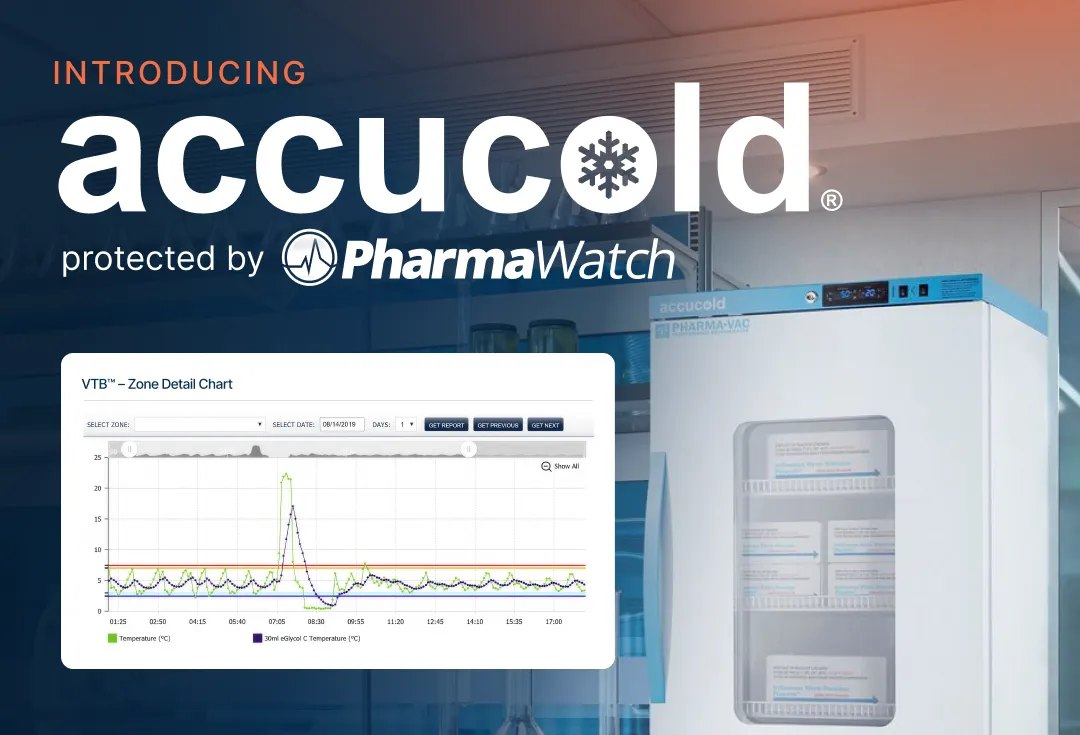
- Setpoint changes show up right away. Our patented Virtual Temperature Buffering™ (VTB™) calculates product temperature in software instead of sticking the probe in a bottle of glycol. You get raw air temperature and modeled product temperature side by side, so a bumped setpoint moves the air reading immediately instead of hiding behind a slow physical buffer.
- QA gets the full timeline. Every reading lands in a portal that supports compliance with FDA 21 CFR Part 11, which is what you need when it's time to reconstruct what happened and when.
No monitor stops an attack. What it does is make sure you're the first to know, while there's still time to move product. That's the difference between the EFS outcome and the supermarket one.
Five things to check this week
None of these need a budget cycle. Most need an afternoon and the right people in the room.
- Find out who can log in to your refrigeration. List every controller, building management system, and vendor portal with remote access to cold storage. If you can't say who has the keys, assume more people do than you'd like. After the EFS attack, France's health ministry switched off remote access to the affected equipment first.
- Ask your equipment vendors about patches. The supermarkets hit on November 2 were running controller software that hadn't been updated. Ask each vendor which firmware you're on and whether it's current.
- Make sure monitoring survives a control-system outage. Pick your most critical freezer and ask: if its controller and our network went down right now, would we still get an alert? If the answer takes a while, that's your answer.
- Run an alarm drill. Trigger a test alert after hours and see who actually picks up, and how long it takes. Update the escalation list while you're at it. Someone on it has probably left.
- Write down where product goes. EFS could move plasma fast because it had somewhere to move it. Know your backup storage, who authorizes a transfer, and how you'll assess anything that may have warmed.
Cybersecurity plans usually stop at the data. These incidents are a good reason to extend yours to the freezers.
The freezer is part of your attack surface now
In three weeks, attackers went from grocery freezers to blood plasma. The one target that came out clean was the one whose alarms did their job.
Nobody's saying every connected fridge is about to get hacked. The point is that trying is getting cheap. AI is shrinking the skill and time an attack takes, and a facility that only plans to keep attackers out is betting it never misses a patch. When what's inside the freezer is irreplaceable, finding out after the fact isn't a plan.
Get the alert before the loss
PharmaWatch runs on its own cellular connection, completely apart from your network and your refrigeration controls. Sensors install in under 20 minutes with zero IT involvement, and alerts escalate until someone answers.
Sources
- CBS News / Associated Press: Blood banks hit by cyberattack in France days after European freezer hacks (Nov 4, 2026)
- Help Net Security: Cyberattack hits French blood banks (Nov 4, 2026)
- Arab News / AFP: Cyberattack targets French blood banks (Nov 4, 2026)
- Fox Business: France blood bank cyberattack targets refrigeration systems as European supermarkets hit (Nov 5, 2026)
- Euronews: Cyberattacks hit supermarket fridges and freezers in Europe (Nov 2, 2026)
- Eastern Eye: European supermarkets hit by second wave of freezer cyberattacks (Nov 2026)
- Associated Press via KSL: Cyberattacks hit European supermarket chains and disrupt refrigeration systems (Oct 13, 2026)
- Nextgov: Pentagon investigates suspected cyberattack behind military freezer failures (Oct 29, 2026)
- Task & Purpose: Pentagon investigates commissary freezer failures as possible cyberattack (Oct 29, 2026)
- Dragos: AI in the Breach: How an Adversary Leveraged AI to Target a Water Utility's OT (May 6, 2026)